
The Game · Analysis
Building Around Barbra Banda
Orlando has secured its leading scorer through 2029. The next challenge is making her individual threat part of a more consistent team.
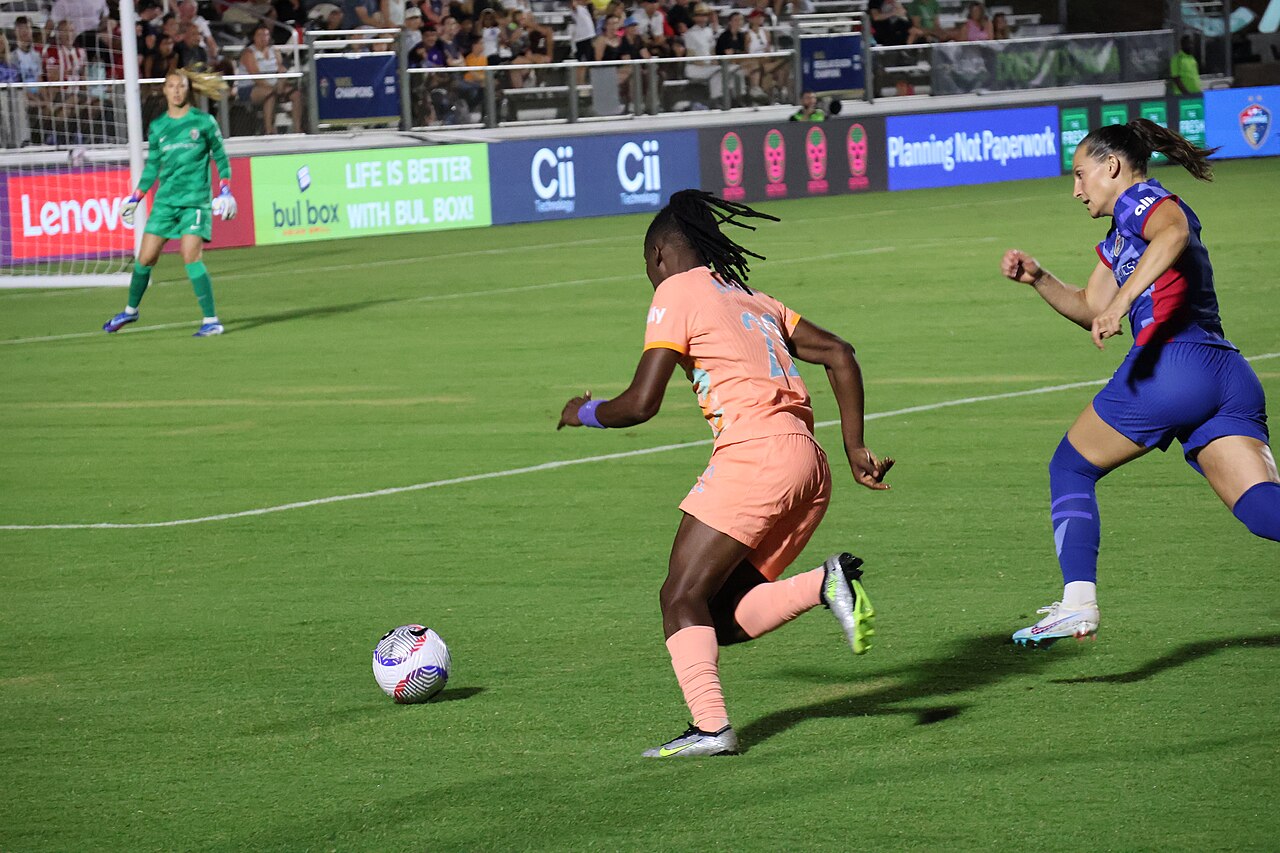
Photo: Hameltion / Wikimedia Commons · CC BY-SA 4.0 · Orlando Pride at North Carolina Courage, June 15, 2024. Archival photograph, not one of the matches discussed here. Resized; displayed crops remain under CC BY-SA 4.0.
Barbra Banda scored twice in Kansas City on September 11. By the 50th minute, Orlando led 2–0. Six minutes later, the scores were level. The match finished 2–2: a point away from home, two more goals for the striker, and a reminder that exceptional finishing and team control are different things. Orlando match report.
Three days later, the Pride announced a new contract keeping Banda at the club through 2029. She had reached 16 league goals for the season, exceeding the club's previous regular-season mark of 13. For Orlando, retaining that production gives the next phase of the team a substantial starting point. Contract announcement.
The more interesting question is what happens around her. How does the ball reach her? What can she create when the shot belongs to someone else? And how does Orlando make those attacking possibilities part of a performance that holds together for a full match?
Selected match reports from the past three seasons offer useful examples. They do not establish every detail of Orlando's tactical system, but they show several different ways Banda can affect a game.
A pass into space becomes a chance
Against Chicago in the November 8, 2024 playoff quarterfinal, Banda scored twice before halftime. For the first, Emily Sams sent a loose ball into space beyond the defense. Banda reached it and finished past Alyssa Naeher. For the second, Ally Watt delivered a lofted pass from Orlando's defensive half, and Banda again got behind the line, this time taking the ball around the goalkeeper. Orlando won 4–1. Quarterfinal report.
Those sequences help explain the value of a forward who can turn a teammate's early pass into a direct route to goal. One began with a defender finding space; the other began much farther from the penalty area. Neither required Orlando to advance through a long sequence of passes before threatening the goalkeeper.
The footballing inference is that this kind of threat gives a team an additional attacking option. The passer still has to recognize the opening and deliver the ball. The runner has to arrive at the right moment and finish. Speed matters, but so does the connection between the two players.
More than one route to goal
Banda's hat trick against Utah on May 23, 2025 showed a different combination of actions. She finished a cross from Watt, intercepted a defensive back pass for her second goal, and reached a forward ball from Haley McCutcheon for her third. Orlando won 3–1. Utah match report.
There is variety within that sequence: finishing a teammate's delivery, recognizing an opponent's mistake, and attacking space after a recovery of possession. The back-pass goal, in particular, does not fit neatly into a story about service. Banda created that opportunity by reacting to a ball the opposition intended to keep.
For a reader trying to understand her game, that is more useful than describing her simply as powerful or fast. Different phases of play can bring her into the attack. A defender has to account for her when Orlando has controlled possession, when the ball changes hands, and when an apparently safe pass becomes vulnerable.
One match cannot show how often those situations occur. It can demonstrate why reducing her contribution to one physical attribute leaves out important parts of the job.
When somebody else finishes
The September 6, 2026 win over Houston provides a more recent example. Banda's ball across goal started the sequence that ended in a Leah Klenke own goal. She then converted a penalty won by Summer Yates. In the second half, she exchanged passes with McCutcheon, who scored Orlando's third. The Pride won 3–1. Houston match report.
The goal and assist are the most visible entries in Banda's individual record from that match. The opening goal shows why those entries do not describe every contribution. Creating a difficult ball across the goalmouth can matter even when the eventual touch belongs to a defender.
The combination with McCutcheon is equally relevant to the idea of building around a striker. It provides a concrete example of Banda helping another player finish an attack. Orlando does not have to choose between supplying her and involving others; a well-timed exchange can do both.
That should remain a question for continued analysis, rather than a sweeping claim about the whole season: how regularly does Orlando turn attention on Banda into opportunities for a teammate?
The team still has to hold together
The contract arrives during a coaching transition. Orlando parted ways with Seb Hines on August 31 and appointed assistant Yolanda Thomas as interim head coach. This is a team adjusting its leadership, not simply extending an uninterrupted championship run. Official coaching announcement.
At Kansas City, Banda's first goal came from a lofted Ally Lemos pass and her second followed service from Hailie Mace. The Current then replied through Temwa Chawinga on a counterattack and Elizabeth Bell after a corner. September 11 match report.
That account supports a limited but important observation: a two-goal contribution from the leading forward did not settle the result. It does not, by itself, identify a particular player or coaching decision as the cause of the lost lead.
The wider football problem is familiar. A team must be able to attack without becoming vulnerable when possession changes, defend the penalty area, and manage the periods when an opponent is pushing back. A prolific striker helps establish a lead. Protecting it involves the rest of the team's work as well.
The extension gives Orlando continuity in one demanding position. It cannot guarantee continuity of results.
What to watch next
Banda's contribution to Orlando already includes the winning goal in the 2024 championship final. Her record gives the club good reason to regard her as a central player in its plans. Orlando's career summary.
For supporters, the next useful questions go beyond whether she scores again. Can she receive with enough support to combine? Do teammates recognize her movement early? Can another attacker become the finishing option when defenders concentrate on her? What does the team do immediately after an attack breaks down?
Answering those questions requires watching the less memorable passages as well as the goals. An attack that ends without a shot can still reveal whether the spacing and timing work. A sequence after possession is lost can show whether the team is positioned to recover.
Building around Banda means developing those connections over time. The evidence already includes runs behind a defense, a finish from a cross, a stolen back pass and an exchange that sent a teammate through to score. The opportunity for Orlando is to make those options repeatable within a team capable of controlling more of the match.
Her new contract establishes who will be part of that work. The football will show how well it comes together.
The extension gives Orlando continuity in one demanding position. It cannot guarantee continuity of results.
Editorial note
This analysis draws on the linked club match reports and announcements. Interpretive passages are GEN SOCCER's analysis of those documented sequences. No original interview or independent full-match video review is claimed. Current information was checked on September 15, 2026.Continue reading

_056.jpg)