The Game · Feature
22,512: A college rivalry at Busch Stadium
A new attendance record offers a reason to revisit Saint Louis and SIUE, and the competition behind a remarkable crowd.
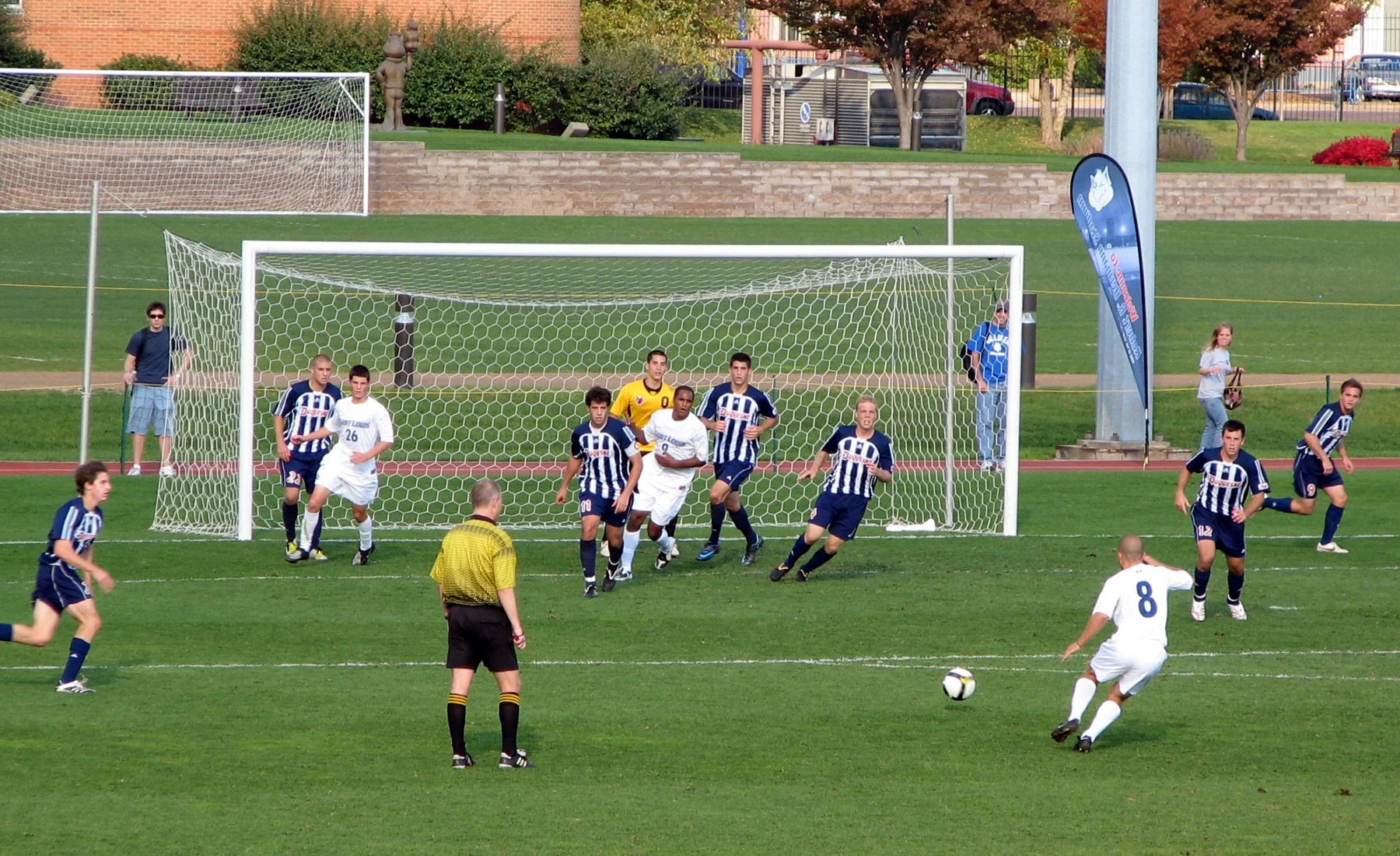
Photo: Wilson Delgado / Wikimedia Commons · Public domain · Saint Louis vs. Duquesne, November 2, 2008. Contextual image, not the 1980 Bronze Boot. Resized and converted to WebP.
On October 30, 1980, Saint Louis University and Southern Illinois University Edwardsville played soccer before 22,512 spectators at Busch Stadium. The fixture was the Bronze Boot, a college rivalry with a place in the city's sporting calendar. Almost 46 years later, its attendance still offers an entry into the competitive history of the American game.
There is a fresh reason to revisit it. On August 20, 2026, Georgia's women beat James Madison 6–0 before 25,433 people at Sanford Stadium. Georgia's official match report identifies that crowd as a new NCAA Division I soccer attendance record, surpassing both the previous women's mark and the longstanding men's record from 1980.
The two evenings invite comparison, but they do not establish a single, uninterrupted growth story. Exceptional fixtures tell us little about an ordinary season's crowds. They can help us ask a more specific question: what gives a college soccer match enough significance for people beyond its immediate campus to attend?
The competition behind the number
Saint Louis won ten NCAA championships between 1959 and 1973. By the time of the record crowd, the program had already accumulated a substantial competitive history. Watching SLU meant watching a team whose university had repeatedly won at the highest level of the college game.
Those titles cannot explain every ticket sold. They do give the fixture a sporting context that a crowd total alone cannot supply. A local audience had seasons, opponents and results to follow. The match at Busch belonged to that continuing competitive life.
The distinction matters for anyone thinking about how to build an audience around college soccer. A large venue offers room for spectators, but the fixture still needs a reason to matter. The useful part of the Bronze Boot story is the relationship between a contest and its audience, rather than a record to be pursued in isolation.
A rivalry that had to return
SIUE's published history records that the regular-season series resumed in 2018 after a 23-year interruption. In 2023, the schools announced a men's and women's doubleheader at CITYPARK. The rivalry has had to find new settings and reconnect with supporters rather than repeat the same event indefinitely.
An exceptional evening can remain prominent in institutional memory even when a competition's regular place in the calendar changes. Preserving a record and sustaining a fixture require different kinds of work. For a rivalry to continue, new players must have the opportunity to make it their own.
This year's meeting supplied an immediate example. On September 6, SIUE beat Saint Louis 1–0 at Korte Stadium in front of 1,947 spectators. According to The Telegraph's match report, Ryley Gibbs scored with a first-half header, while goalkeeper Ioannis Koupepides made five saves.
That crowd should not be read as a measurement of decline from 1980. Such a comparison would require information about capacity, ticketing, promotion and the circumstances of both matches. The result tells us something more direct: the rivalry still produces a sporting contest with a trophy at stake. Winning a header and protecting a lead give the history its present-day meaning.
What follows a record evening
Georgia's occasion also drew on a sporting history attached to its venue. The university scheduled the match to honor the 30th anniversary of the U.S. women's Olympic gold-medal victory at Sanford Stadium. Its event connected a current college team to a previous generation's achievement.
For the Bulldogs, attention then returned to the regular season. The university's record-night report directed supporters to the next match at the Turner Soccer Complex, with free admission and recognition for the team's seniors. That invitation is a practical example of the work that follows a major occasion; it is not, by itself, evidence of how many spectators returned.
The longer-term questions concern repeat attendance, recognition of individual players and an audience's attachment to the team across a season. A record crowd creates an opportunity to deepen those connections. The record alone cannot tell us whether that happened.
The Bronze Boot remains worth revisiting because it connects college competition to a specific place and a continuing rivalry. Its most memorable number belongs to an evening in 1980. Its next result belongs to the players who take the field now.
A record crowd creates an opportunity to deepen connections between a team and its audience.
Editorial note
This historical analysis draws on published university records and attributed match reporting. It does not include new interviews or an eyewitness reconstruction of the 1980 match.Sources and further reading
Continue reading